
How to Make Your Restaurant Show Up in AI Search Results
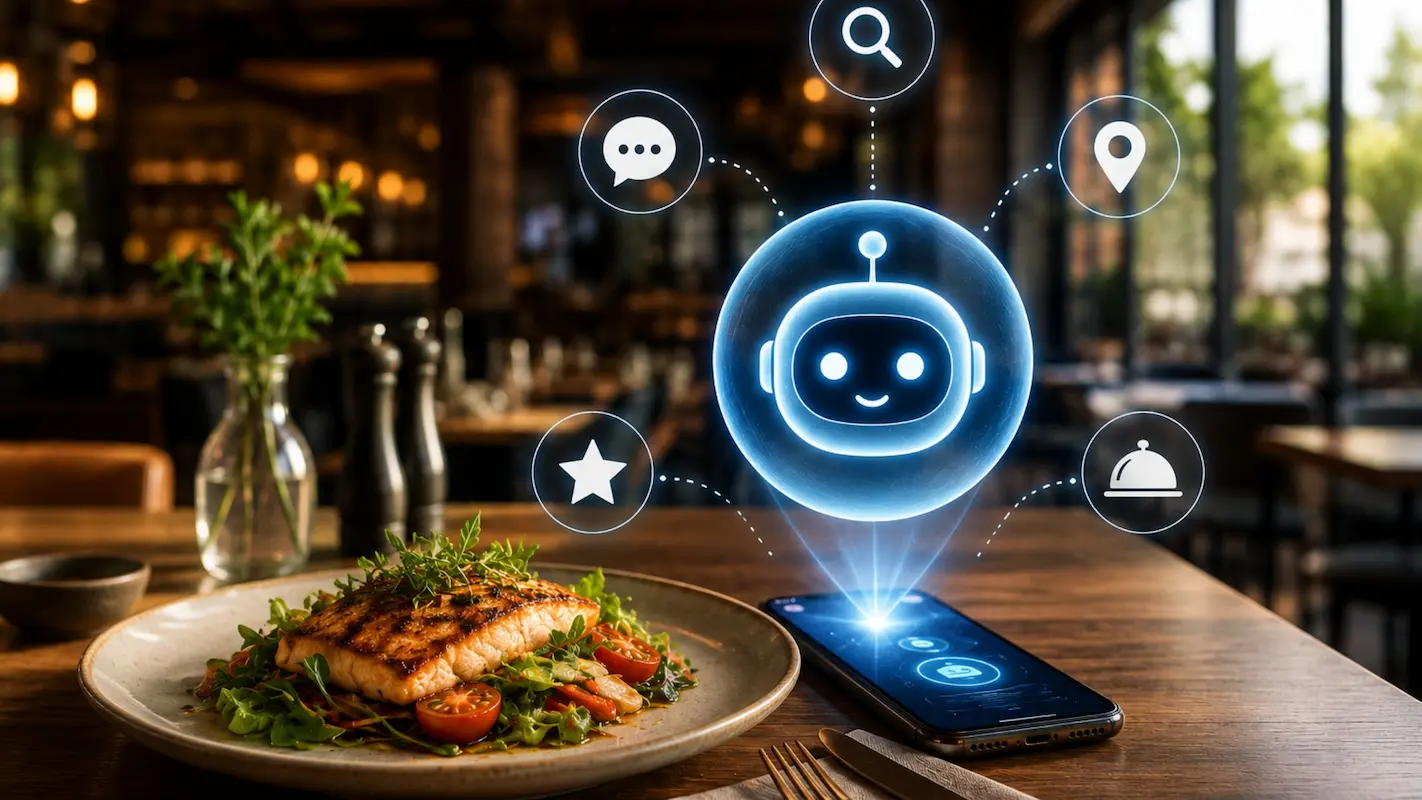
A customer in Dubai opens ChatGPT on their phone and types: “What is a good Lebanese restaurant in JLT with outdoor seating?” ChatGPT gives three recommendations with descriptions, mentions, and reasons to visit. Your restaurant is not one of them — even though you have been in JLT for four years, have 400 Google reviews, and serve some of the best mezze in the city.
This is the new visibility problem. And it is happening to restaurants across Dubai right now.
Search has changed fundamentally. Google AI Overviews, ChatGPT search, Perplexity, and Bing Copilot are now answering restaurant queries directly — without sending users to a list of links. If your restaurant is not optimized for how these AI systems source and select information, you are invisible in an entirely new layer of search. Restaurant AI search optimization is no longer a future consideration. It is a present-tense problem with a present-tense solution.
How Is AI Search Different From Traditional Google Search for Restaurants?
Traditional Google search works on a ranking model. You optimise your website and Google Business Profile, earn backlinks and reviews, and Google ranks your pages in a list that users scroll through and click. The user does the choosing.
AI search works on a recommendation model. When someone asks ChatGPT or Google AI Overview for a restaurant recommendation, the AI synthesises information from multiple sources and presents a direct answer with specific suggestions. The AI does the choosing — and it makes that choice based on how well your digital presence communicates trustworthiness, relevance, and authority to a machine reading language, not just keywords.
For Dubai restaurants, this shift is significant. The city has one of the highest rates of AI tool adoption in the world, and food discovery via conversational search is growing rapidly among the younger, tech-savvy demographic that makes up a large portion of Dubai’s dining audience.
What Are Google AI Overviews, ChatGPT Search, and Perplexity?
These are the three AI platforms most likely to influence restaurant discovery right now:
Google AI Overview appears at the top of Google search results for many queries. It generates a summarised answer using content from high-authority web pages, structured data, and Google Business Profile information. It is currently the highest-traffic AI discovery channel for local businesses.
ChatGPT Search is OpenAI’s search-integrated version of ChatGPT, which browses the web in real time and synthesises answers from credible sources. Users ask conversational questions and get direct restaurant suggestions based on what ChatGPT finds online.
Perplexity is an AI answer engine that cites its sources directly. It is growing rapidly in the UAE tech community and is particularly trusted for research-style queries like “best brunch spots in Dubai Marina with reviews.”
Why Most Dubai Restaurants Are Invisible in AI Search Right Now
The majority of Dubai restaurants have not yet adapted their digital presence for AI readability. Their websites were built for human readers and traditional search crawlers — not for large language models that read content differently.
Common reasons Dubai restaurants are not appearing in AI search results:
- Website content is vague, image-heavy, and lacks descriptive text about cuisine, location, and experience
- No structured schema markup telling AI systems what type of business this is, where it is, and what it serves
- Google Business Profile is incomplete or inconsistently maintained across platforms
- No FAQ content on the website for AI systems to extract direct answers from
- Online mentions are sparse or inconsistent — AI systems cross-reference multiple sources to validate recommendations
- Review volume and recency are insufficient to establish credibility in AI training data
The restaurants appearing in AI recommendations in Dubai right now are not necessarily the best — they are the best described, the most consistently mentioned, and the most structurally readable by AI systems. That gap is closeable, and it starts with understanding what generative engine optimization actually means.
What Is Generative Engine Optimization for Restaurants?
Generative Engine Optimization, or GEO, is the practice of structuring your restaurant’s digital presence so that AI-powered search engines can accurately understand, trust, and recommend your business. It sits alongside traditional SEO but requires a different approach.
Where traditional SEO focuses on keywords and backlinks, GEO focuses on clarity, authority, and structured information. The goal is to make your restaurant easy for a language model to read, understand, and confidently cite as a credible recommendation. Our full breakdown of AEO and GEO for restaurants covers this in more depth, but here is the practical summary.
GEO vs SEO — What Is the Actual Difference?
| Factor | Traditional SEO | Generative Engine Optimization |
| Primary goal | Rank in search results | Get cited by AI answer engines |
| Key signals | Keywords, backlinks, page speed | Structured data, clarity, authority, citations |
| Content style | Keyword-optimised paragraphs | Direct answers, FAQ format, descriptive prose |
| Local signals | NAP consistency, local links | GBP completeness, review volume, platform mentions |
| Measurement | Rankings, organic traffic | AI citation frequency, GBP visibility, brand mentions |
Both matter. GEO does not replace SEO — it builds on top of it. A restaurant with strong traditional local SEO foundations is already halfway to being AI-visible. The additional layer is making that content readable and citable by machines.
How Does AI Decide Which Restaurants to Recommend?
This is the question every Dubai restaurant owner should understand. AI recommendation engines do not have a single algorithm — but they share common signals they use to evaluate whether a restaurant is worth recommending.
| AI Platform | How It Sources Restaurants | Key Optimization Signal |
| Google AI Overview | Google index, GBP, structured data | Schema markup, GBP completeness, review recency |
| ChatGPT Search | Live web browsing, credible sources | Website content quality, press mentions, blog citations |
| Perplexity | Real-time web with citations | Authority of sources citing your restaurant |
| Bing Copilot | Bing index, structured data | Bing Places listing, structured website content |
The common thread across all four is this: AI systems recommend restaurants that are well-described, consistently mentioned across credible platforms, and backed by clear structured data. Volume of evidence and clarity of description are the two most important factors.
How to Optimize Your Restaurant for Google AI Overviews
Google AI Overview draws from three main sources: your website content, your Google Business Profile, and structured data on your pages. Optimizing all three in alignment gives you the strongest possible signal.
Start with your website content. Every page should describe your restaurant in clear, specific prose. Not just your cuisine — your atmosphere, your signature dishes, your location context, your dining experience. AI systems need descriptive content they can pull from and paraphrase confidently. Vague taglines and image galleries do not feed AI recommendations.
Structured Data and Schema Markup for Restaurant Pages
Schema markup is code you add to your website that explicitly tells search engines and AI systems what type of business you are, where you are located, what you serve, and how to contact you. For restaurants, the most important schema types are:
- Restaurant schema — business name, cuisine type, address, opening hours, price range
- Menu schema — individual dishes with names, descriptions, and prices
- Review schema — aggregated review score and review count
- LocalBusiness schema — geographic coordinates, service area, contact details
- FAQ schema — question-and-answer pairs that AI systems can extract directly
Without schema markup, AI systems have to guess what your restaurant is and what it offers. With it, you are handing them the exact information they need to recommend you accurately. Work with your digital marketing team or developer to implement these on your site.
How Your Google Business Profile Feeds AI Recommendations
Your Google Business Profile is one of the most influential signals for Google AI Overview recommendations. An incomplete or outdated profile is one of the fastest ways to be excluded from AI-generated local restaurant suggestions.
Optimise your GBP for AI visibility with these specific actions:
- Complete every field — business category, attributes, service options, accessibility features
- Upload fresh photos monthly — AI systems cross-reference visual presence as a freshness signal
- Post weekly updates including menu changes, events, and seasonal offers
- Respond to every review — response activity signals an active, credible business
- Ensure your name, address, and phone number exactly match every other platform where your restaurant is listed
- Add your menu directly inside GBP using the menu section — this is a direct feed for AI food discovery queries
Your GBP is the first place to start if you want faster AI visibility. It is also where the biggest gaps are for most Dubai restaurants we review through our restaurant SEO and delivery app ranking service.
How to Get Your Restaurant Recommended by ChatGPT and Perplexity
ChatGPT Search and Perplexity work differently from Google AI Overview. They browse the live web and synthesise from whatever credible sources they find — which means your restaurant needs to exist in places beyond just your own website.
The sources these platforms pull from most reliably include:
- Food and lifestyle blogs that have reviewed or mentioned your restaurant
- News articles or press features — even small local outlets count
- Social media mentions from accounts with meaningful followings
- Third-party review platforms — Zomato, TripAdvisor, Time Out Dubai, What’s On Dubai
- Your own blog content if it is well-written and indexed
For Dubai restaurants, getting featured on Time Out Dubai, What’s On Dubai, or Zomato’s editorial content is one of the highest-value actions for ChatGPT and Perplexity visibility. These are the sources these AI systems trust most in the UAE market.
What Kind of Content Do LLMs Pull From?
Large language models favour content that is specific, authoritative, and directly answers questions. When writing content for your restaurant website or blog, structure it around the questions your potential customers ask:
- What type of cuisine does your restaurant serve
- What is the atmosphere and dining experience like
- What are the must-order dishes
- Where exactly is the restaurant located
- What are the opening hours and price range
- Is the restaurant suitable for families, groups, business dining
Each of these should be answered clearly and specifically on your website. Vague marketing language does not get cited by AI. Specific, useful descriptions do. Learn how to build this kind of content through our content marketing ideas for Dubai F&B brands.
AEO Content Strategy — How to Write So AI Answers With Your Restaurant
Answer Engine Optimization, or AEO, is the content-side complement to GEO. Where GEO focuses on technical signals, AEO focuses on how you write content so AI engines pull from it directly when answering user questions.
The most effective AEO content structure for restaurants follows this pattern:
- Question as heading — use the exact question your customer would ask
- Direct answer in the first sentence — answer the question immediately, not after three paragraphs of context
- Supporting detail in two to four sentences — expand on the direct answer with useful specifics
- Repeat for every key question — build a library of direct-answer content across your site
This format is what Google AI Overview and ChatGPT extract from most reliably. It is also why FAQ pages and blog posts with clear question-based headings earn a disproportionate share of AI citations.
How to Structure FAQs for AI Answer Engines
Your FAQ page and the FAQ sections within your blog posts are among your highest-value AI optimization assets. For each FAQ entry:
- Write the question exactly as a customer would type or speak it
- Keep the answer between 40 and 80 words — concise enough for AI to extract, detailed enough to be useful
- Use plain language — no marketing speak, no jargon
- Cover location, cuisine, hours, experience, price, and booking in your FAQ coverage
- Implement FAQ schema markup so Google can read the structured data directly
BrandXB builds AEO content strategies for F&B brands across Dubai and the UAE as part of our broader food and beverage digital marketing services. The restaurants that invest in this now will hold a structural advantage over competitors for years — because most are still not doing it.
Is Your Restaurant Ready for AI Search? Start With BrandXB
AI search is not replacing Google. It is adding a new layer on top of it — and that layer is already influencing where Dubai diners choose to eat. The restaurants that appear in ChatGPT recommendations, Google AI Overviews, and Perplexity answers are capturing discovery moments that their competitors are completely missing.
Getting there is not about gaming a new algorithm. It is about building a digital presence that is accurate, authoritative, and readable by machines — which is the same thing that makes you credible and trustworthy to humans.
BrandXB helps Dubai F&B brands build that presence. From schema implementation and GBP optimization to AEO content strategy and Meta retargeting, we combine every layer of digital visibility into one integrated approach. Read our full guide on how to retarget restaurant customers with Meta ads in Dubai to see how paid and organic strategies work together.
If you want your restaurant to show up where the next generation of customers is searching, start a project with BrandXB today.
FAQs
How do I get my restaurant to show up in AI search results?
Start with three foundations: a fully optimised Google Business Profile, restaurant schema markup on your website, and descriptive content that directly answers common customer questions. These are the signals Google AI Overview and ChatGPT use most heavily when generating restaurant recommendations. Consistent mentions across credible third-party platforms like Zomato and Time Out Dubai also significantly improve your AI visibility.
What is generative engine optimization and does my restaurant need it?
Generative Engine Optimization or GEO is the practice of structuring your restaurant’s digital presence so AI-powered search engines can read, trust, and recommend your business. Every restaurant that wants to remain visible as search behaviour shifts toward AI answer engines needs GEO. In Dubai, where AI tool adoption is high and food discovery via conversational search is growing, the window to build this advantage early is right now.
Does ChatGPT recommend local restaurants in Dubai?
Yes. ChatGPT Search browses the live web in real time and recommends specific restaurants based on what it finds across credible sources including review platforms, food blogs, news features, and restaurant websites. Dubai restaurants with strong presence on Time Out Dubai, Zomato, TripAdvisor, and their own well-structured websites are most likely to appear in ChatGPT recommendations for local dining queries.
How does Google AI Overview decide which restaurants to feature?
Google AI Overview draws from three primary sources: your website content, your Google Business Profile, and structured schema data on your pages. Restaurants with complete GBP listings, high review volume and recency, restaurant schema markup, and clear descriptive content on their websites are most likely to be selected. Freshness signals — recent posts, new photos, recent review responses — also contribute to AI Overview inclusion.
What schema markup does a restaurant need for AI search visibility?
The most important schema types for restaurant AI visibility are Restaurant schema covering business name, cuisine, address, hours, and price range; Menu schema with individual dish names and descriptions; Review schema showing aggregated scores; LocalBusiness schema with geographic coordinates; and FAQ schema for question-and-answer content. Implementing all five gives AI systems a complete, structured picture of your restaurant that dramatically improves recommendation eligibility.
How is AEO different from traditional SEO for restaurants?
Traditional SEO optimises your content for keyword rankings in Google search results. AEO optimises your content to be directly extracted and cited by AI answer engines like Google AI Overview, ChatGPT, and Perplexity. AEO requires writing in a direct question-and-answer format, implementing FAQ schema, and ensuring every key customer question is answered clearly and specifically on your website. Both strategies work together — AEO builds on a strong SEO foundation rather than replacing it.